TSU Formula Student: A Chinese Podium Without a Car
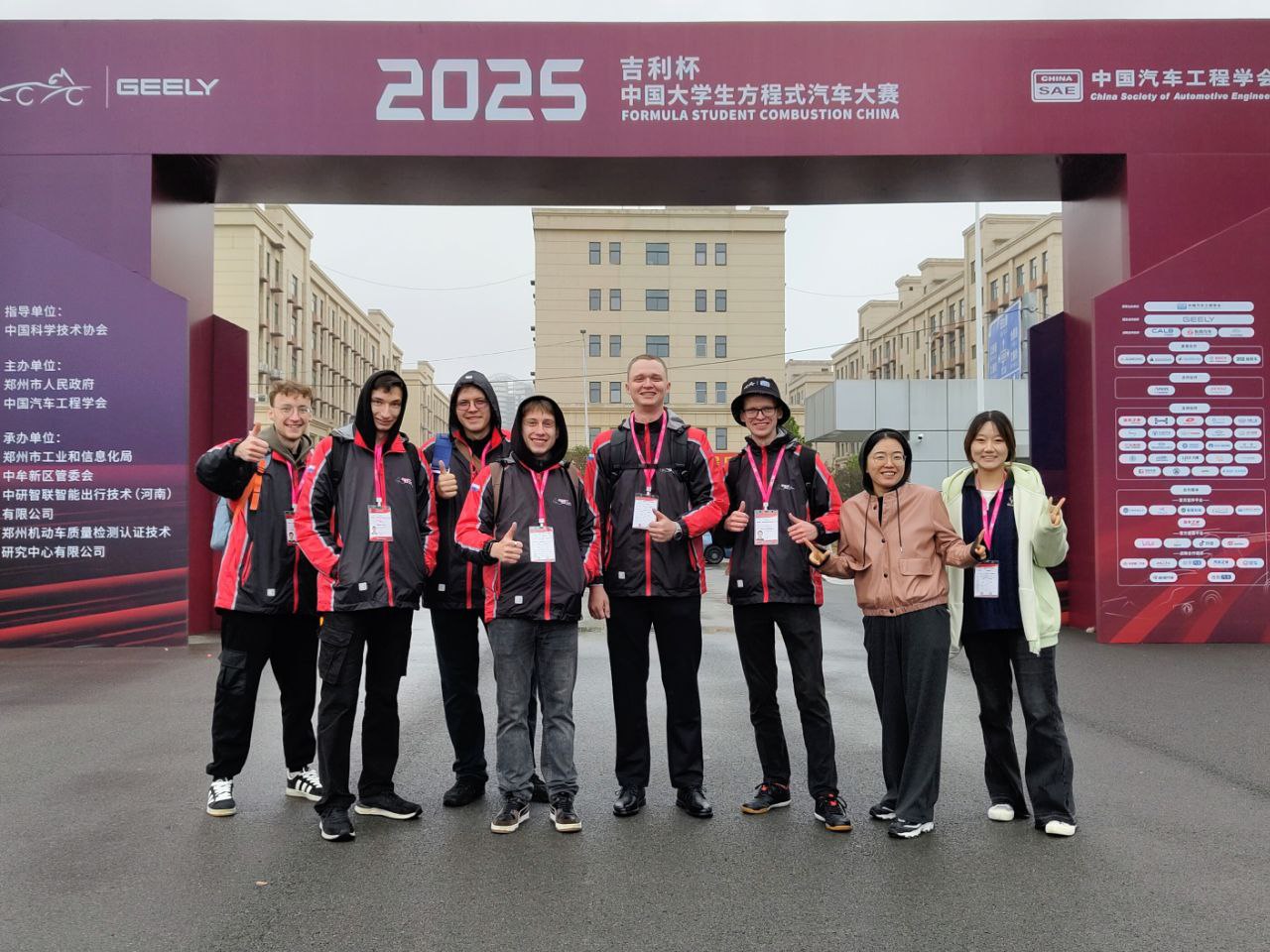
Due to the substantial costs associated with transporting a vehicle internationally and complex registration requirements in China, the Togliatti team participated exclusively in static disciplines this year, where engineering documentation and scale models substitute for physical vehicles. Students from the Zhengzhou Railway Vocational and Technical College joined the TSU team as part of a collaborative entry.
The number of teams participating in Formula Student China has increased significantly: while 48 teams competed last year, this year's competition included over 60. And the competition, according to the TSU delegation members, was very tough. Nevertheless, the team delivered a strong performance, securing a podium finish in the Business Plan Presentation discipline for the second consecutive year.
“The team's performance in the Business Plan Presentation was outstanding,” notes Alexander Bobrovsky, Director of the TSU Mechanical Engineering Center and Head of the Department of Automobile Design and Operation. “Notably, Kirill Popov, a newcomer who had only recently advanced to his second year of study, represented the team. This was his first international competition, and he achieved an impressive result.”
Overall, we were in the average statistics, missing out on last year's result by only nine and a half points. Given the increased number of participants and heightened competitive intensity, this performance represents a consistent level of achievement. The team's participation in international competitions can therefore be considered successful.
“Competing without a car, only in static driving, the maximum you can score is 300-320 points,” explains Alexander Bobrovsky. “That's no more than the top 40 in the overall standings, which is, of course, unfortunate. With a car, we could compete just as well as we did at Russian competitions; we've already competed successfully against very strong Chinese teams. But without a car, we can't participate in dynamic disciplines, which means we're clearly short of the nearly 600 points that are up for grabs in dynamic driving.
So why even bother going at all under these circumstances? The strategic rationale for participation under these constraints is clear: to maintain world-class competitiveness, team members require experience in international competitions. Without such exposure and training, the Formula Student project at TSU risks stagnation. Participation, even without a vehicle, is essential for the team's long-term viability.
“As long as our students retain the skills to understand international best practices, they will continue to develop both vehicle designs and digital documentation at a globally competitive level,” states Alexander Bobrovsky. “Missing even a single international competition would make it difficult to return to previous performance levels. Due to graduation, we will lose several highly capable team members this year. Incoming students are not competent and experienced enough. Therefore, the primary objective of this trip was knowledge transfer, ensuring that our current level of expertise is passed to the next generation to preserve team continuity. Additionally, exposure to Chinese vehicle designs allows us to analyze best practices and potentially integrate innovative features. Without such international observation, we risk falling behind technologically, and our students may design non-competitive systems.”
Our Chinese colleagues have provided significant assistance to the Togliatti Racing Team. As is well known, Togliatti State University has a cooperation agreement with the Changzhou Vocational and Technical Institute of Mechatronic Technology. In addition to formal contacts, personal, informal connections are also flourishing. Alexander Bobrovsky's connections at another university, the Zhengzhou Railway Vocational and Technical Institute, greatly facilitated the organization of the TSU students' trip to China. The institute's staff provided hospitality, logistical support, and accommodation for the Togliatti team members, which is a significant contribution considering that China operates completely differently than we are accustomed to. Russian and European bank cards are not accepted, carsharing and driving are not permitted for foreigners, and numerous administrative complications abound. Furthermore, the language barrier, particularly with regard to the hieroglyphic writing found on all maps, documents, and signs, can complicate routine activities.
“Frankly speaking, they gave us significantly more than we gave them,” notes Alexander Bobrovsky. “They nurtured us, helping us overcome all the legal and cultural barriers, and selflessly served as translators. At the same time, in China, participation in Formula Student is considered very prestigious; it's practically a party requirement for universities, and if a university somehow manages to get involved in this project, its national standing rises significantly. Therefore, including students from the Railway Institute on our team for the competition was mutually beneficial.”
383
views