How Researchers Are Turning Poison into Medicine
Classical targeted therapy operates on a “blocker” principle: drugs suppress mutant proteins within cancer cells. However, this approach has a significant limitation: tumor genetic instability drives continuous mutation, enabling cancer cells to develop resistance and ultimately rendering treatment ineffective.
An alternative strategy leverages proteolysis – the cell's natural system for clearing damaged or obsolete proteins.
“For this purpose, a PROTAC is designed: a chimeric molecule that functions as a molecular messenger. The molecule comprises two ligand fragments connected by a linker. One ‘claw’ binds to the target protein designated for destruction; the second ‘claw’ engages a specialized 'executioner' protein from the E3 ligase family – such as cereblon (CRBN). The linker physically brings the target and executioner into proximity.” explains Alexander Bunev, Director of the Center for Medicinal Chemistry (CMC) at Togliatti State University. “When both claws engage their targets, cereblon tags the target protein for degradation, and the cell directs it to the proteasome – the cellular recycling system.”
This mechanism elevates disease intervention to a new level: rather than merely blocking a pathogenic protein, it initiates a program for its complete elimination.
CRBN is a key component of chimeric molecules. The discovery of its interaction with the ligand thalidomide played a fundamental role in understanding its work.
“Thalidomide is a historically notorious drug that caused severe birth defects in the mid-20th century. It turns out that by binding to cereblon, it alters it, causing it to attack completely different target proteins, including those responsible for normal embryonic development. Paradoxically, this 'misdirected' activity proved therapeutically valuable for treating multiple myeloma. (a malignant disease of the blood system – Ed.),” notes Alexander Bunev. “Myeloma cells have their own 'survival proteins' – Ikaros and Aiolos. Thalidomide, by altering cereblon, causes it to recognize and target these proteins for destruction.”
Deprived of its critical components, the cancer cell dies. However, scientists faced a dilemma.
“Thalidomide is an effective yet unpredictable 'hook' for cereblon,” continues Alexander Bunev. “If a PROTAC incorporating thalidomide were used to treat, for example, lung cancer, it would similarly degrade Ikaros and Aiolos in healthy hematopoietic cells upon entering the bloodstream, causing severe off-target effects. This created a new challenge for modern pharmaceuticals: designing molecules that bind to cereblon without altering its native substrate specificity or compromising other proteins.”
A collaborative team from St. Petersburg State University, the Center for Medicinal Chemistry at Togliatti State University, and the Max Planck Institute for Physics (Munich, Germany) is addressing this challenge through a multi-stage research pipeline.
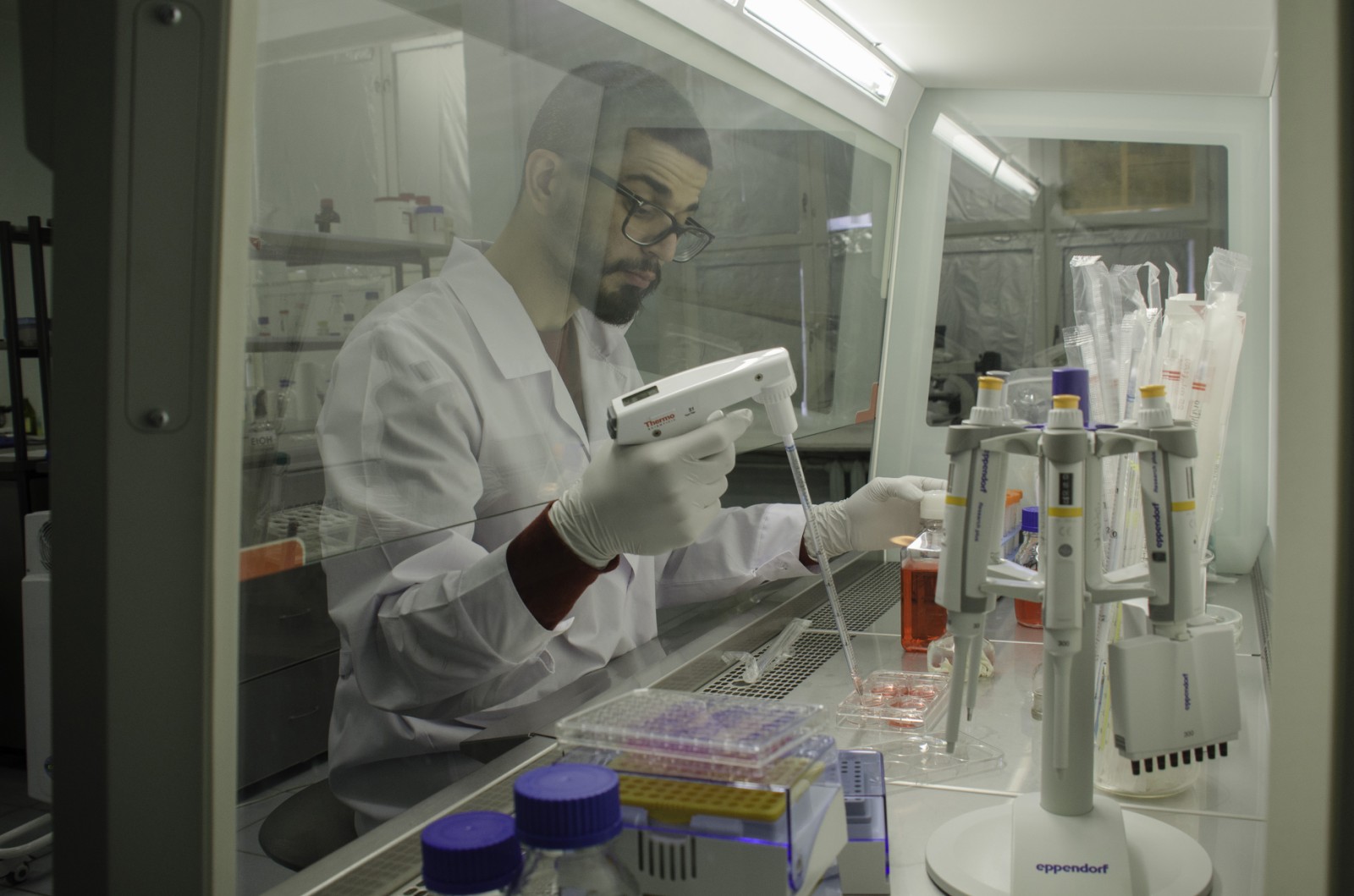
Chemists in St. Petersburg are creating new promising ligands for cereblon, while scientists at the TSU Center for Medicinal Chemistry are using computer modeling and cellular assays to test how the new molecules penetrate and interact with cells – the Center for Medicinal Chemistry has an impressive collection of cell lines. Professor Markus Hartmann's group in Germany is using X-ray crystallography to obtain precise 3D models of ligand binding to cereblon.
“We at the Center for Medicinal Chemistry conducted a Thermal Shift Assay and experimentally demonstrated that the ligands synthesized by our colleagues do indeed stabilize cereblon in cells using a specific method. However, a critical question remained: cells contain thousands of proteins. Could our ligands cause CRBN to degrade unintended, previously unknown proteins?” says Alexander Bunev.
To answer this question, Professor Eric Fisher's research group from Harvard Medical School, a global leader in quantitative proteomics (a field of analytical chemistry dedicated to the identification and quantitative analysis of proteins), joined the collaboration. The American researchers' method allows them to "count" all the thousands of proteins in a cell before and after drug exposure. If the concentration of a protein drops, it means it has been degraded.
Experimental results were highly promising: scientists not only confirmed that their ligands do not affect known “off-target” proteins (Ikaros, Aiolos), but they also proved that no new ones are created. This finding is critically important for the development of drugs against solid tumors, where blood side effects have been a major limitation.
“Despite current challenges in international collaboration, this joint study has proven highly effective. We have developed a universal methodology for identifying new active compounds based on a specific chemical structure – glutarimide. Most importantly, we have validated biologically active structures, which serve as ready-made 'building blocks' for constructing fully functional 'chimeras.' In other words, our findings pave the way for the creation of new anticancer drugs with a fundamentally new mechanism of action,” comments Dmitry Dar'in, Professor in the Department of Medicinal Chemistry at the Institute of Chemistry at St. Petersburg University.
Based on these results, the researchers plan to carry out large-scale work on the design and synthesis of new, more effective compounds.
“The ultimate goal is to create a molecule that, using internal cellular mechanisms, will specifically destroy a protein vital to cancer cells, leading to their death. This is an ambitious but entirely achievable goal, made possible by our effective international collaboration,” emphasized Dmitry Dar'in.
The scientists described the experimental results in an article published in the European Journal of Medicinal Chemistry.
638
views